|
|
|
Supreme Court Backs Police in Chase Case
Breaking Legal News |
2007/04/30 07:46
|
| The Supreme Court on Monday gave police officers protection from lawsuits that result from high-speed car chases, ruling against a Georgia teenager who was paralyzed after his car was run off the road. In a case that turned on a video of the chase in suburban Atlanta, Justice Antonin Scalia said law enforcement officers do not have to call off pursuit of a fleeing motorist when they reasonably expect that other people could be hurt. Rather, officers can take measures to stop the car without putting themselves at risk of civil rights lawsuits. "A police officer's attempt to terminate a dangerous high-speed car chase that threatens the lives of innocent bystanders does not violate the Fourth Amendment, even when it places the fleeing motorist at risk of serious injury or death," Scalia said. The court sided 8-1 with former Coweta County sheriff's deputy Timothy Scott, who rammed a fleeing black Cadillac on a two-lane, rain-slicked road in March 2001. Victor Harris (nyse: HRS - news - people ), the 19-year-old driver of the Cadillac, lost control and his car ended up at the bottom of an embankment. Harris, paralyzed, sued Scott. Lower federal courts ruled the lawsuit could proceed, but the Supreme Court said Monday that it could not. Justice John Paul Stevens dissented. In an unusual move, the court posted the dramatic video on its Web site. |
|
|
|
|
|
|
U.S. court to decide case of Mexican on death row
Breaking Legal News |
2007/04/30 06:49
|
| The U.S. Supreme Court said on Monday it would decide whether President George W. Bush had the authority to direct a state court to comply with an international tribunal's ruling in the case of a Mexican on death row in Texas. The justices agreed to review a decision by the Texas Court of Criminal Appeals that concluded Bush had exceeded his constitutional authority by intruding into the independent powers of the judiciary. The case involved Jose Medellin, who was denied the right to meet with a consular officer from Mexico after his arrest for murder. The World Court in The Hague in 2004 ordered the United States to review the cases of Medellin and 50 other Mexican death row inmates because U.S. officials failed to tell them of their right under the Vienna Convention to talk to consular officers immediately after their arrests. Bush in 2005 decided to comply with the World Court's ruling and he directed state courts to review the 51 cases to determine whether the violation of their rights caused the defendants any harm at trial or at sentencing. Bush's action caused the Supreme Court to dismiss an earlier appeal by Medellin without deciding the merits of the dispute and to send the case back to the Texas courts. After losing before the Texas Court of Criminal Appeals, Medellin's attorneys again appealed to the Supreme Court. They said the Texas court has put the United States in violation of its undisputed treaty obligations. Bush administration attorneys supported Medellin's appeal. They said Bush acted within his authority and that the Texas court invalidated a presidential action "on a matter of international importance." Medellin, a gang member, was sentenced to death in state court for the 1993 rape and murder of two teenage girls in Houston. The brutal killings stemmed from a gang initiation. Lawyers for the state opposed the appeal. They said Bush exceeded his authority and that he cannot pre-empt Texas criminal law. The Supreme Court will hear arguments and decide the case during its upcoming term that begins in October. |
|
|
|
|
|
|
NATO to investigate Afghan prison abuse allegations
International |
2007/04/29 08:50
|
North Atlantic Treaty Organization (NATO) Secretary General Jaap de Hoop Scheffer said Saturday that NATO will investigate allegations of human rights violations committed by Afghan prison officials. Scheffer's comments follow allegations made by Canadian human rights groups that Canada, a NATO member and prime contributor to ISAF, NATO's security assistance force in Afghanistan, is violating international human rights law and the Canadian Charter of Rights and Freedoms in allowing detainees initially held in Canadian custody to be turned over to Afghan forces, where they suffer abuse. The groups have filed suit against the Canadian government alleging that the current Canada-Afghanistan Detainee Agreement does not do enough to ensure detainees will not be tortured by Afghan forces. Scheffer said that NATO countries have the responsibility to defend international human rights, and that NATO has an obligation to prevent Afghanistan from torturing prisoners in its facilities. |
|
|
|
|
|
|
Executions down worldwide in 2006
International |
2007/04/29 08:49
|
The number of executions worldwide dropped in 2006 from 2,148 the year previous to 1,591, according to new statistics issued by Amnesty International. Over 90 percent of the year's executions were conducted in six countries: Iran, Iraq, Sudan, Pakistan, the USA and China. At 177, Iran's execution rate nearly doubled in 2006. Iraq and Pakistan joined the ranks of the world's deadliest regimes with 65 hangings and at least 82 executions respectively, and Amnesty reported at least 1000 executions in China, where rights activists say the true total may be closer to 8000. The United States, with 53 executions in 2006, is the only Western Hemisphere country to have carried out any executions since 2003. Amnesty said that some 20,000 prisoners remain on death row worldwide, and repeated its call for a worldwide moratorium on executions, noting that 99 countries - most recently, the Philippines - now support a ban on capital punishment for ordinary crimes. |
|
|
|
|
|
|
D.C. Judge's pants lost, he sues for $65 Million
Court Watch |
2007/04/28 17:12
|
Roy Pearson started legal action claiming Custom Cleaners lost a pair of suit trousers he took in for $10 alterations two years ago. The cleaners' lawyers offered to pay Pearson, an administrative law judge for the District of Columbia, as much as $12,000 to end the row. But astonishingly, Pearson is pressing ahead through the courts with the unbelievable claim for $65,462,500.
Pearson, an administrative law judge in Washington DC, claims he's owed the money because he devoted more than 1000 hours to represent himself in the battle.He insists he has been put through "mental suffering, inconvenience and discomfort". And because he does not have a car, he says he'll now have to RENT one just to get his clothes cleaned at another store.
According to court papers, Pearson dropped off his trousers on May 3, 2005. But they were not ready when he returned later.
Aweek later, the cleaners came up with grey trousers they said were Pearson's - but he insisted they were not the ones he dropped off.
This week, DC Superior Court judge Neal Kravitz said: "The court has significant concerns that the plaintiff is acting in bad faith because of the breathtaking magnitude of the expansion he seeks."
Lawyer Chris Manning, representing Custom Cleaners' owners Ki, Jin and Soo Chung, said: "They have been abused in a ghastly way. It's going to cost them tens of thousands to defend this case."
The Chung family insist his trousers are still at the store, waiting to be collected. |
|
|
|
|
|
|
Changes Urged for Student Privacy Law
Law Center |
2007/04/28 12:19
|
| A lawmaker who also is a child psychologist wants Congress to better define when a university can release students' mental health information to their parents. Last week's massacre at Virginia Tech shows the need for such legislation, said Rep. Tim Murphy, R-Pa. Virginia Tech student Seung-Hui Cho, 23, went on a shooting spree in a dormitory and classroom building on campus, killing 32 people and himself. It is unclear what, if any, contact the university had with Cho's parents even after a professor removed him from class for violent writing and disruptive behavior. Murphy said he would introduce a bill that would allow a university to notify a student's parents without fear of violating privacy laws if that student is deemed to be at risk of committing suicide, homicide or physical assault. The Federal Educational Rights and Privacy Act of 1974 allows access to records in case of an emergency or to protect the health of a student. Parents also can be notified if the student consents. But the law is written too vaguely, Murphy said in a letter to House colleagues. "There are many examples where information was not released to parents or guardians regarding a student's mental health, which led to miscommunications and withholding of vital information that would have prevented suicides, assaults and other crimes," Murphy said. A magistrate ordered Cho in December 2005 to have an evaluation at a private psychiatric hospital after two women complained about annoying calls from him, and an acquaintance reported he might be suicidal. An initial evaluation found probable cause that Cho was a danger to himself or others as a result of mental illness. David Shern, president of Mental Health America, an advocacy group for people with mental illness, said Murphy's plan sounds reasonable, but he would like to see the specifics. |
|
|
|
|
|
|
New York governor unveils gay marriage bill
Political and Legal |
2007/04/28 12:18
|
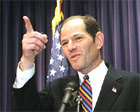
| New York Governor Eliot Spitzer (D) introduced a bill Friday to legalize gay marriage in New York. In a press release, Spitzer said: Under current law, partners unable to enter into a civil marriage - and their children - lack legal protections taken for granted by married couples. In such areas as property ownership, inheritance, health care, hospital visitation, taxation, insurance coverage, child custody and pension benefits, married couples receive important safeguards against the loss or injury of a spouse, and crucial insurance against legal intrusion into marital privacy. Spitzer reportedly seeks to fulfill a campaign promise he made last October in his run for governor to support a gay marriage bill. In response, State Senate Majority Leader Joseph Bruno (R) announced that he still opposed recognizing same-sex marriage, and suggested that in the wake of the recent killing of a New York state trooper Spitzer should put more priority on reintroducing the death penalty for criminals who kill police officers. Spitzer has admitted that his bill is unlikely to receive support from state lawmakers. Gay marriage advocates nonetheless applauded the bill as a step forward. "Today is a watershed moment in our community's struggle to win the freedom to marry," said Alan Van Capelle, executive director of gay rights group Empire State Pride Agenda. |
|
|
|
|
|
|
Class action or a representative action is a form of lawsuit in which a large group of people collectively bring a claim to court and/or in which a class of defendants is being sued. This form of collective lawsuit originated in the United States and is still predominantly a U.S. phenomenon, at least the U.S. variant of it. In the United States federal courts, class actions are governed by Federal Rules of Civil Procedure Rule. Since 1938, many states have adopted rules similar to the FRCP. However, some states like California have civil procedure systems which deviate significantly from the federal rules; the California Codes provide for four separate types of class actions. As a result, there are two separate treatises devoted solely to the complex topic of California class actions. Some states, such as Virginia, do not provide for any class actions, while others, such as New York, limit the types of claims that may be brought as class actions. They can construct your law firm a brand new website and help you redesign your existing law firm site to secure your place in the internet. |
Law Firm Directory
|
|


 Legal News RSS Feed